Trading Meme Coins With a Tiny Portfolio
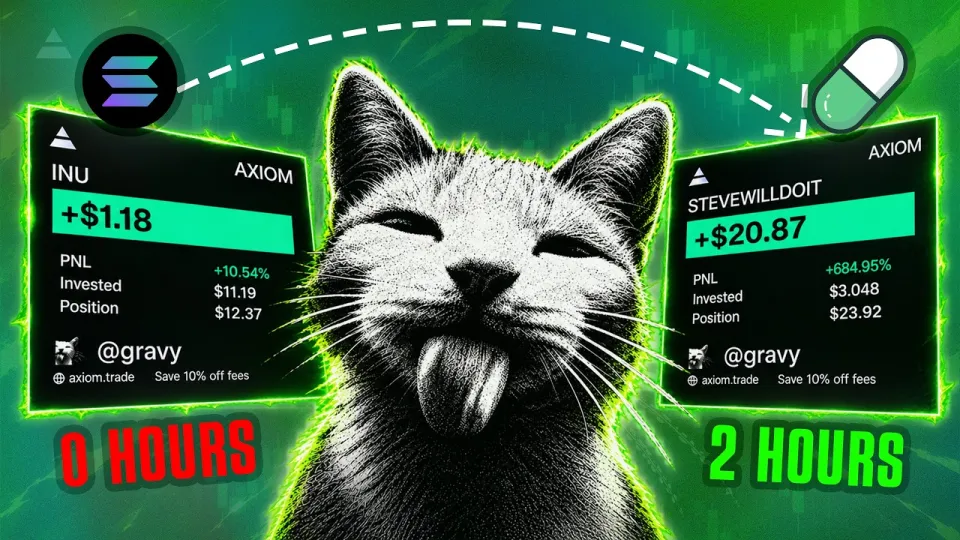
Video: I Tried Trading Memecoins with Just $10
You can order the same kind of articles for your own video to boost it on YouTube and Google. Just message the Telegram bot @sat_sit_bot. Articles with your video embedded are written and posted by the bot itself — on popular topical sites (no ads). Your first 50 articles are free.
· based on the channel gravy
Meme coin trading with a small portfolio is possible, but only if position size, fees and exit discipline are treated as a single problem rather than three separate ones. A $10 account on Solana can still take real trades — the practical ceiling is roughly 0.05 SOL per buy, which keeps gas and swap fees from swallowing the position. The channel gravy tested exactly this in a five-trade run, buying STEVEWILLDOIT, NPC, MET, PUMPY and UNTXD through Axiom, a trading terminal that offers referral cashback and reduced fees.
What a $10 meme coin portfolio actually allows
A ten-dollar balance is not a strategy problem, it is a fee problem. On Solana, every round trip costs a slice of the position: priority fees, the DEX or launchpad fee, and slippage on the way in and out. When a buy is 0.05 SOL, a few cents of friction is a meaningful percentage, so the only way the math works is to size up relative to fixed costs and to avoid trades that need a 2x just to break even.
The rules that follow from that are simple:
- Cap each entry at a fixed fraction of the balance, in the video's case under 0.05 SOL.
- Prefer coins with live volume — thin books multiply slippage on both sides.
- Treat the first partial recovery as a chance to take the initial risk off, not as a signal to add.
- Count fees as part of the loss on every trade, because on a small account they are.
A small portfolio does not remove risk; it changes which risks matter. Rug risk and narrative risk stay identical, while fee drag and minimum trade sizes become the binding constraints.
The five trades and the narratives behind them
Each of the five positions was chosen for a reason that could be stated in one sentence, which is the useful test for any meme coin thesis. STEVEWILLDOIT rode a recognisable internet meme format; NPC played on the NPC-and-ai-agent theme that keeps resurfacing in crypto; MET was tied to Meteora; PUMPY the Trader leaned on the pump.fun launchpad culture; UNTXD was the last of the run.
The X Money meta — the cluster of coins built around e/acc and Cream — is the clearest example of how these narratives form. A single high-profile account or product announcement creates a story, the story gives buyers a reason to look, and the earliest entrants get paid by the later ones. That is the whole mechanism. It is not fundamentals, and it does not last; the coin is a vehicle for attention, and attention decays.
What separates a workable narrative from noise is timing relative to that attention curve. Buying a story everyone has already heard is buying the exit liquidity of the people who heard it first.
Reading a narrative before you buy
The hardest part of meme coin trading is not execution, it is filtering. Anyone scrolling a timeline sees dozens of candidate coins a day, and the honest failure mode is not picking the wrong one — it is buying a dip in a coin whose story has already peaked, then selling at a 20–40% loss just before it bounces without you.
A workable filter looks like this:
- Age of the story. If the coin is already being quoted by accounts that do not usually post memes, the early phase is over.
- Who is talking and why. Influencer attention is a signal only when it is early and specific, not when it is a generic call.
- Liquidity and holder distribution. A coin with a handful of wallets holding most of the supply will not let a small trader exit cleanly.
- Your own feed. Curating the timeline so it shows launch activity rather than unrelated chatter is a real edge; several viewers asked how to clean theirs up, and the answer is aggressive muting and following launchpad-adjacent accounts.
None of this predicts price. It only keeps you out of the trades where the outcome is already decided against you.
Position sizing and exits on a sub-0.05 SOL budget
On a small balance, the exit matters more than the entry. A trade that goes up 40% and is held for a 5x gives back most of the gain on the way down, and with fees on top the round trip can end negative. Taking a portion off when the position is up enough to cover costs plus a margin is the only reliable way to survive a string of losers.
Practical mechanics for a $10 account:
- Enter with a single buy, never average down into a coin that has already broken its thesis.
- Set a mental invalidation level before entering and honour it — small accounts cannot afford hope.
- Sell into strength in pieces; the book is thin and a full exit at the top is rarely available.
- Log every trade with entry, exit and fee so the next decision is based on data rather than memory.
The video is candid that one of the five trades was fumbled badly, which is more instructive than a clean win streak. Execution errors — hesitating, selling the whole position at the first red candle, or chasing after the move — cost more on a small account than a bad coin choice does.
Common questions from small-account traders
Viewers of the run raised the same concerns that come up whenever someone trades meme coins with a tiny balance. The most frequent is how to find coins with good narratives without living on social media; the answer is to narrow the sources rather than widen them, following a small set of accounts that are early rather than loud.
The second is what the total profit and loss was. That number is the only honest scoreboard, and a run of five trades is far too small a sample to draw conclusions from either way — variance dominates at that size. The third is whether live trading from a small balance makes sense as a next step; streaming 0.1 SOL or 1 SOL with a public wallet turns the exercise into a documented track record, which is useful, but it also removes the privacy that lets a trader make mistakes quietly.
The fourth is tooling. Axiom is the terminal used throughout, and its referral program gives 2x cashback and 15% lower fees, which matters disproportionately when positions are this small.
Useful links
- Axiom trading terminal with referral cashback: https://axiom.trade/@gravy
- The Trenches Discord: https://discord.gg/W7TqkExcSd
- Discord with free Axiom imports and trade signals (NFA): https://discord.gg/9W5j3XUgYB
- gravy on X: https://x.com/gravyski
- Leverage trading with 20% futures fee reduction: https://www.bitbase.com/landing-page/trading-earning-Gra?ref=8CYOGY
Bottom line
Trading meme coins with $10 is not a path to meaningful income, but it is a legitimate way to learn execution, fee structure and narrative timing with money that does not hurt. The five-trade run from gravy shows the realistic shape of it: small entries under 0.05 SOL, a thesis that can be stated in one line, exits taken in pieces, and at least one mistake that costs more than the fees do. Anyone repeating the experiment should expect the fees and the psychology to be the real opponents, not the coins. If you want to follow the same setup, start through Axiom with the referral link and keep the first positions small enough that a full loss is unremarkable.
Key takeaways
- Five real meme coin trades, each buy kept under 0.05 SOL — roughly the size a $10 account allows.
- Coins covered: STEVEWILLDOIT, NPC, MET (Meteora), PUMPY the Trader and UNTXD.
- Trades were executed through Axiom, which advertises 2x cashback and 15% lower fees via referral.
- The X Money meta (e/acc, Cream) is used to explain how a narrative pulls fresh money into a coin.
- One of the five trades was badly mishandled — the video breaks down the mistake rather than hiding it.
Source: I Tried Trading Memecoins with Just $10 · Markdown version
Questions & answers
Can you really trade meme coins with only $10?
Yes, technically — on Solana a $10 balance supports buys of around 0.05 SOL, which is enough to take real positions. The constraint is fees and slippage rather than minimum size, so each trade has to be large enough relative to fixed costs to be worth doing at all.
How do you find meme coins with a strong narrative?
Narrow your sources instead of widening them: follow a small set of accounts that post early rather than loudly, and mute everything unrelated so the timeline shows launch activity. A thesis should be expressible in one sentence — if it needs a paragraph, the story is probably already priced in.
Why do small accounts lose money even on coins that go up?
Fees, slippage and exits. A round trip on a thin book can cost a meaningful share of a 0.05 SOL position, and holding for a large multiple usually means giving most of the gain back on the way down. Taking partial profits early is what keeps a small account alive.
Is a five-trade run enough to judge whether meme coin trading works?
No. Five trades is far too small a sample and variance dominates at that size, so a winning streak proves as little as a losing one. What the run is useful for is process: sizing, fee awareness and honest logging of mistakes.